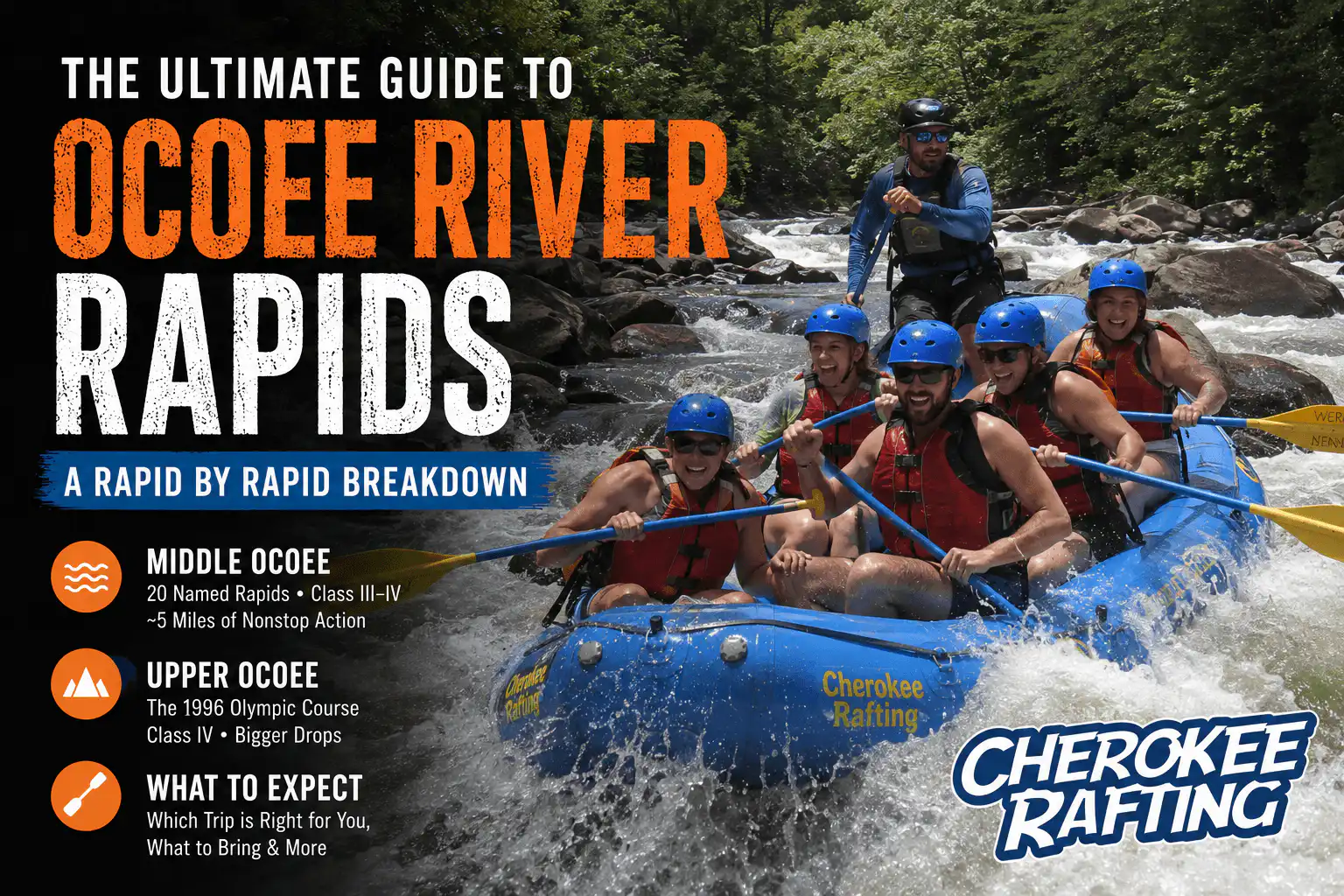
If you’ve scrolled through photos of a raft disappearing into a wall of whitewater and wondered what exactly you’d be getting into, you’re not the only one. The Ocoee is one of the only rivers around where the rapids stack up almost back to back, with barely a flat stretch to catch your breath. That’s part of why it hosted the 1996 Olympic whitewater events, and why it’s still the most popular rafting river in the Southeast.
Here’s a rapid by rapid look at what you’ll actually paddle through on the Middle and Upper Ocoee, so you know what’s coming before you ever climb in the raft. And if you’re still working out the logistics of your trip, our guides to the best time to go and what to wear and bring cover everything else you’ll want to know before you book.
Quick Answer: What Class Rapids Are on the Ocoee River?
The Ocoee is mostly Class III and Class IV rapids, with a few Class II stretches thrown in so you can shake the water out of your eyes. It breaks into two sections:
- Middle Ocoee: about 5 miles, roughly 20 named rapids, mostly Class III and IV, open to most guests
- Upper Ocoee: about 5 miles, including the actual 1996 Olympic whitewater course, with a handful of Class IV drops that hit harder and require more technical paddling than the Middle
Neither section climbs to Class V. That’s a big part of why the Ocoee works so well for first timers while still giving experienced paddlers plenty to be excited about.
Middle Ocoee Rapids: What to Expect
The Middle Ocoee is the trip most people run first, and honestly, the one most outfitters build their name on. Here’s a look at some of the named rapids you’ll hit, roughly in the order you come to them after putting in below the dam.
Grumpy’s kicks things off. It’s a long, rolling Class III that eases you in while still splashing everyone in the boat. From there you’ll work through Gonzo Shoals, a shallow, ledgy stretch that keeps the raft moving and rewards a crew that’s actually paddling together and not just holding on.
Broken Nose is where things get more interesting. It’s a multi drop Class III+ that bends the raft through a few different moves before finishing in a hole your guide already knows how to read. A little further downstream you’ll hit Double Suck, a ledge with two holes set close together, and Double Trouble, which throws some of the biggest waves you’ll see on the Middle Ocoee along with a favorite surf spot guides love to let the raft linger in.
Table Saw is a turbulent, churning Class III+ with big waves down the middle and a sneaky pothole tucked near the bottom right. Diamond Splitter comes next, named for the huge boulder sitting in the middle of the current. Most rafts run to the right of it, and the pocket just below is one of the better play spots on the river.
Near the end of the run you’ll pass Hell Hole, a well known feature that’s easy to avoid with the right line but fun to watch other rafts test. Then it’s Powerhouse, the Middle Ocoee’s last real rapid, run along the right side to skip the biggest hole before you settle into the calm paddle to the takeout.
That’s just a sample. The Middle actually packs close to 20 named drops into five miles, which is a big reason the whole run feels nonstop compared to most rivers you’ve probably rafted before. Our guides run this stretch daily in season, so if you want the full story behind the company running your raft, take a look at meet our guides.
Upper Ocoee Rapids: The Olympic Course
The Upper Ocoee is a different experience altogether. TVA only releases water for it on select days each season, separate from the Middle’s schedule, which is part of why it feels a little more special and why people who’ve done both sections usually say the Upper hits harder.
The run opens with a few warm up rapids, Bush Gardens, Tombstone, and Mikey’s Ledge, before dropping into the actual 1996 Olympic slalom course. That stretch includes Best Ledge, the entrance to the Olympic section and a diagonal wave that soaks the whole raft on the way in, and Smiley Face, named for a smiley face painted on a rock that only shows up at low water. It’s trickier than a Class III has any right to be.
Then comes Slam Dunk, the single biggest drop on the Olympic course, followed by Callihan’s Ledge, a fast, punchy ledge that sets up the two rapids everyone actually books this trip for: Godzilla and Humongous. They come back to back, both Class IV, and they’re the reason most guests choose the Upper Ocoee in the first place. Godzilla throws so much spray you’ll lose sight of the person paddling in front of you, and Humongous follows right after with one of the biggest wave trains on the entire river.
If Table Saw and Broken Nose are the signature challenges of the Middle Ocoee, Godzilla and Humongous are the Upper’s, bigger water, tighter margins, and a story worth telling once you’re back on dry land.
Middle vs. Upper Ocoee: Which One Should You Book?
The Middle Ocoee is the better call for first timers, families, and most groups. It’s continuous and splashy but forgiving, and it runs most days during the season, so it’s easy to fit into a trip. The Upper Ocoee is the pick if you want bigger, more technical whitewater. It has fewer rapids overall, but the ones it does have hit harder, and since TVA only releases water for it on select days, you’ll want to plan around the schedule rather than showing up and hoping.
If Table Saw, Broken Nose, and Diamond Splitter sound like your speed, go Middle. If you’re chasing Godzilla, Humongous, and Slam Dunk, go Upper.
Can’t pick just one? A Full River trip combines both sections in a single day, so you get the nonstop fun of the Middle and the Olympic caliber drops of the Upper without having to choose between them. You can compare all three trip options on our trip info page.
Is the Ocoee River Safe for Beginners?
Yes. You don’t need any rafting experience to run either section with a guide. You just need to be able to follow paddle commands and meet the minimum age requirement. Every trip starts with a safety talk on shore, and you’ll be fitted with a helmet, life jacket, and paddle before you even touch the water. Guides sit at the back of the raft the whole trip, reading the rapids in real time and steering the boat through the lines described above, so you’re never out there navigating on your own.
That said, this is real whitewater, not a lazy float down the river. Expect to get soaked, expect a bump or two, and expect at least one rapid that gets your heart pounding a little. That’s kind of the whole point. If you’ve got more questions before you book, our FAQ page covers most of what first timers ask us.
When to Raft the Ocoee River
The season runs roughly March through October, and a few things are worth knowing before you book. Spring, March and April, brings cooler water and air but great flow and thinner crowds. Summer, May through August, is peak season with warm water, the fullest release schedule, and the busiest weekends. Fall, September and October, means smaller crowds and gorgeous mountain color, though the Upper Ocoee’s release schedule tends to wind down earlier than the Middle’s.
Because the Upper Ocoee only runs on select days, if Godzilla and Humongous are the goal, it’s smart to lock in your date early instead of hoping to grab one at the last minute. For a deeper look at picking the right week for your trip, check out our full breakdown of the best time to go.
If you’re making a weekend of it, it’s also worth planning where you’ll stay and what else there is to do nearby, since most guests turn their rafting trip into a full trip to the area.
Frequently Asked Questions
How many rapids are on the Ocoee River? Between the Middle and Upper sections combined, the Ocoee has more than 30 named rapids, making it one of the most continuous whitewater runs in the country.
Are there any Class V rapids on the Ocoee? No. The Ocoee tops out at Class IV, which keeps it accessible for first time rafters while still delivering a serious whitewater experience for guests who come back year after year.
Which is more intense, the Middle or Upper Ocoee? Most guides and guests point to the Upper Ocoee, mainly because of Godzilla and Humongous, two back to back Class IV rapids with bigger, more technical water than anything on the Middle section.
What’s the minimum age to raft the Ocoee? Most outfitters set the minimum age at 12 for both sections, since the trip requires guests to actually paddle and follow commands through continuous whitewater.
Do I need rafting experience to run the Upper Ocoee? No. Guides take first time rafters down the Upper Ocoee all the time. You just want to go in knowing it’s a faster, bigger water experience than the Middle section.
Ready to Run These Rapids Yourself?
Reading about Table Saw and Godzilla is one thing. Feeling them under your raft is another. Book a Middle Ocoee, Upper Ocoee, or Full River trip with Cherokee Rafting and let one of our guides show you every rapid on this list in person.